Europe
Spain entered the war as a French ally with the goal of recapturing Gibraltar and Minorca, which had been captured by an Anglo-Dutch force in 1704. Gibraltar was besieged for more than three years, but the British garrison stubbornly resisted and was resupplied twice: once after Admiral Rodney's victory over Juan de Lángara in the 1780 "Moonlight Battle", and again by Admiral Richard Howe in 1782. Further Franco-Spanish efforts to capture Gibraltar were unsuccessful. One notable success took place on February 5, 1782, when Spanish and French forces captured Minorca, which Spain retained after the war. Ambitious plans for an invasion of Great Britain in 1779 had to be abandoned.West Indies and Gulf Coast
-
 The Battle of the Saintes fought on April 12, 1782 near Guadeloupe.
-
 Norteamerica, 1792, Jaillot-Elwe, Florida's borders after Bernardo Gálvez's military actions.
-
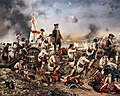 Spanish forces at the Siege of Pensacola (1781).


In the Gulf Coast campaign, Count Bernardo de Gálvez, the Spanish governor of Louisiana, quickly removed the British from their outposts on the lower Mississippi River in 1779 in actions at Manchac and Baton Rouge in British West Florida. Gálvez then captured Mobile in 1780 and stormed and captured the British citadel and capital of Pensacola in 1781. On May 8, 1782, Gálvez captured the British naval base at New Providence in the Bahamas; it was ceded by Spain after the Treaty of Paris and simultaneously recovered by British Loyalists in 1783. Gálvez' actions led to the Spanish acquisition of East and West Florida in the peace settlement, denied the British the opportunity of encircling the American forces from the south, and kept open a vital conduit for supplies to the American frontier. The Continental Congress cited Gálvez in 1785 for his aid during the revolution and George Washington took him to his right during the first parade of July 4.[131]
Central America was also subject to conflict between Britain and Spain, as Britain sought to expand its informal trading influence beyond coastal logging and fishing communities in present-day Belize, Honduras, and Nicaragua. Expeditions against San Fernando de Omoa in 1779 and San Juan in 1780 (the latter famously led by a young Horatio Nelson) met with only temporary success before being abandoned due to disease. The Spanish colonial leaders, in turn, could not completely eliminate British influences along the Mosquito Coast. Except for the French acquisition of Tobago, sovereignty in the West Indies was returned to the status quo ante bellum in the peace of 1783.
India
Main article: Second Anglo-Mysore War


No comments:
Post a Comment